
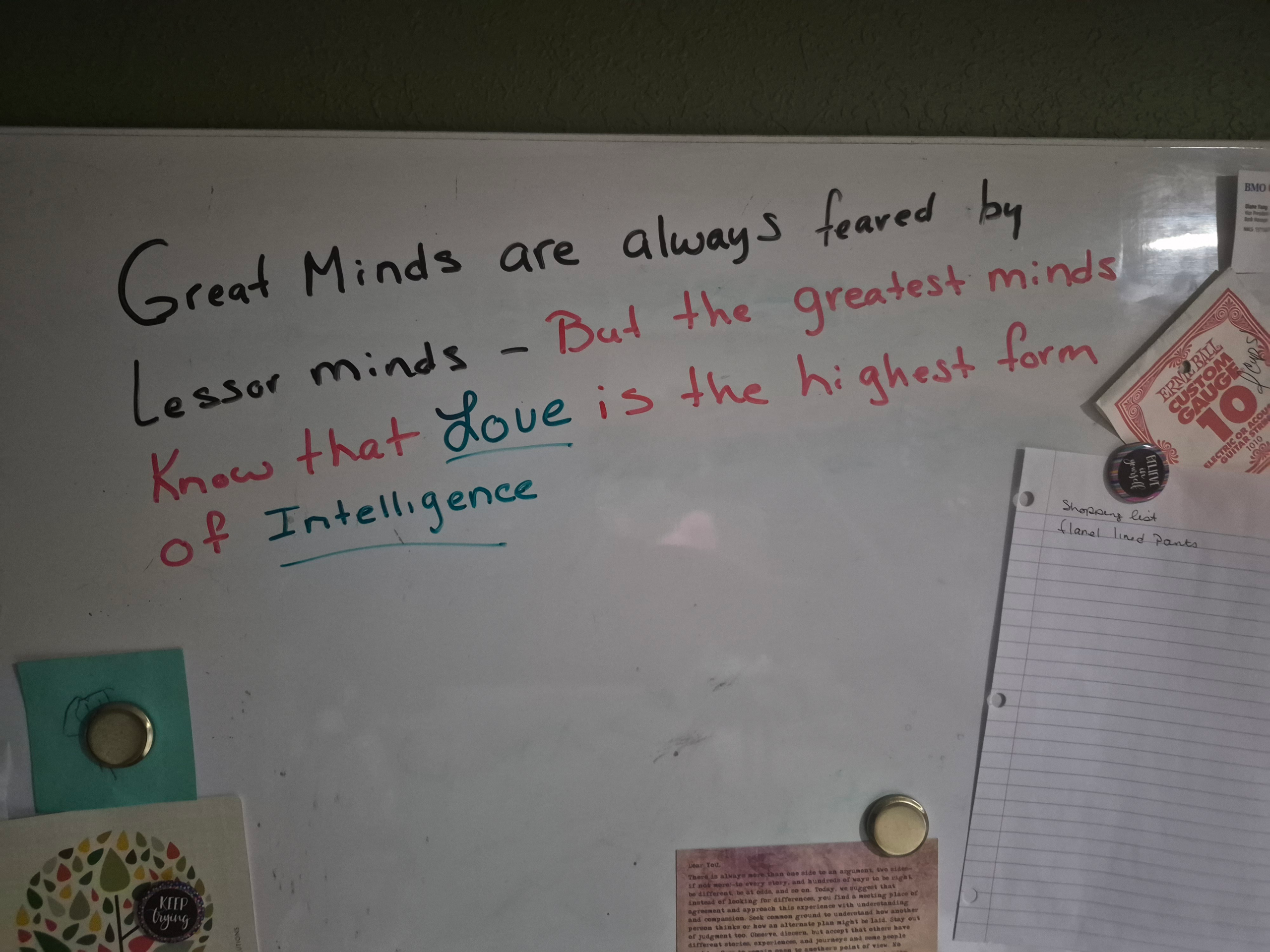
Adapted from:
“Great minds are always feared by lesser minds.”
— Dan Brown, The Lost Symbol
This whiteboard began with a familiar truth.
Dan Brown’s line captures something many people have experienced: that depth, originality, and expanded thinking often provoke discomfort. Great minds disrupt comfort zones. They ask questions that unsettle certainty. And because of that, they are often misunderstood—or feared.
But as we sat with that thought, it felt incomplete.

So the whiteboard kept going.
“But the greatest minds know that love is the highest form of intelligence.”
This wasn’t written to contradict the original quote.
It was written to evolve it.
Intelligence alone isn’t the summit. Insight without empathy can become sharp, brittle, even isolating. Knowledge without compassion may impress—but it rarely heals, connects, or sustains.
The greatest minds don’t need to prove themselves.
They don’t dominate conversations or protect their brilliance with walls.
They understand that love isn’t naïve—it’s discerning.
Love requires awareness.
Love requires restraint.
Love requires the ability to see beyond fear, ego, and the need to be right.
That kind of love doesn’t dilute intelligence.
It refines it.
In our relationship, this shows up daily. In moments where we could choose defensiveness and instead choose understanding. In conversations where being “right” matters less than being kind. In remembering that connection is not built by winning—but by staying present.
This whiteboard wasn’t written as a declaration of superiority.
It was written as a reminder.
That growth isn’t measured by how sharp our minds are,
but by how gently we use them—
especially with the people we love.
Because in the end, love isn’t the opposite of intelligence.
It’s its highest expression.
This reflection was inspired by Dan Brown’s quote from The Lost Symbol and expanded through our daily whiteboard practice.
© Copyright 2026. Powered by WordPress Hosting.